

Porcelain countertops have moved from a niche European option to one of the fastest-growing surface choices in Canadian kitchens. They promise marble looks without marble maintenance, and Italian factories lead the category.
But porcelain is unforgiving when specified wrong. The wrong thickness, the wrong edge detail, or the wrong fabricator can turn a premium surface into a costly callback. This guide covers what to know before you commit.
What Are Porcelain Countertops?
Porcelain countertops are large-format slabs made from refined clays and minerals, fired at over 1,200°C. The result is a dense, non-porous surface that is harder than most natural stone.
Slabs are printed with high-resolution patterns, from Calacatta marble to concrete and oxidized metal. Premium Italian producers now offer full-body veining, where the pattern runs through the slab rather than sitting on the surface.
| Property | Porcelain Slab |
|---|---|
| Typical thickness | 12mm (standard), 20mm (premium) |
| Slab format | Up to 1600 × 3200mm |
| Porosity | Near zero, no sealing required |
| Heat resistance | Excellent, hot pans safe |
| Scratch hardness | 7–8 on the Mohs scale |
| UV stability | Colourfast, suitable outdoors |
| Installed cost in Canada | Roughly C$80–C$160 per sq ft |
Pros of Porcelain Countertops
The case for porcelain rests on performance. It resists what kitchens throw at it.
Heat is the headline advantage. A hot pan straight from the burner will not scorch or crack the surface, which quartz cannot claim.
Stains are the second win. The surface is non-porous, so wine, coffee, and lemon juice wipe away without sealing. There is no annual maintenance routine, ever.
Porcelain is also light. A 12mm slab weighs far less than 30mm granite, which reduces load on cabinetry and can allow installation over an existing counter. Outdoors, UV stability means colours will not fade on a patio kitchen.
Cons of Porcelain Countertops
Porcelain’s weakness is impact, not wear. Edges and corners can chip if struck hard, and a dropped cast-iron pan is the classic culprit.
Repairs are possible with colour-matched adhesive. They are rarely invisible.
Pattern depth is the second limitation. On surface-printed slabs, a chip can expose a different colour underneath. Full-body Italian slabs avoid this, but they cost more.
The biggest risk is fabrication. Porcelain demands specialized diamond tooling and experience, and far fewer Canadian shops handle it well compared to granite or quartz. A bad cut cracks the slab, and the failure often appears months later.
How to Specify Porcelain Countertops Right
Getting porcelain right is a specification exercise. Three decisions determine whether the surface performs for decades or fails in year one.
Choose the Right Thickness
For standard kitchen runs, 12mm is the industry benchmark. It is lighter, cheaper, and fully adequate where the counter sits flat on cabinetry.
For islands with seating overhangs, specify 20mm. A 12mm slab is limited to roughly 15cm of unsupported overhang, while 20mm cantilevers much further and roughly doubles breaking strength. Overhangs beyond the limit need steel supports, agreed before fabrication.
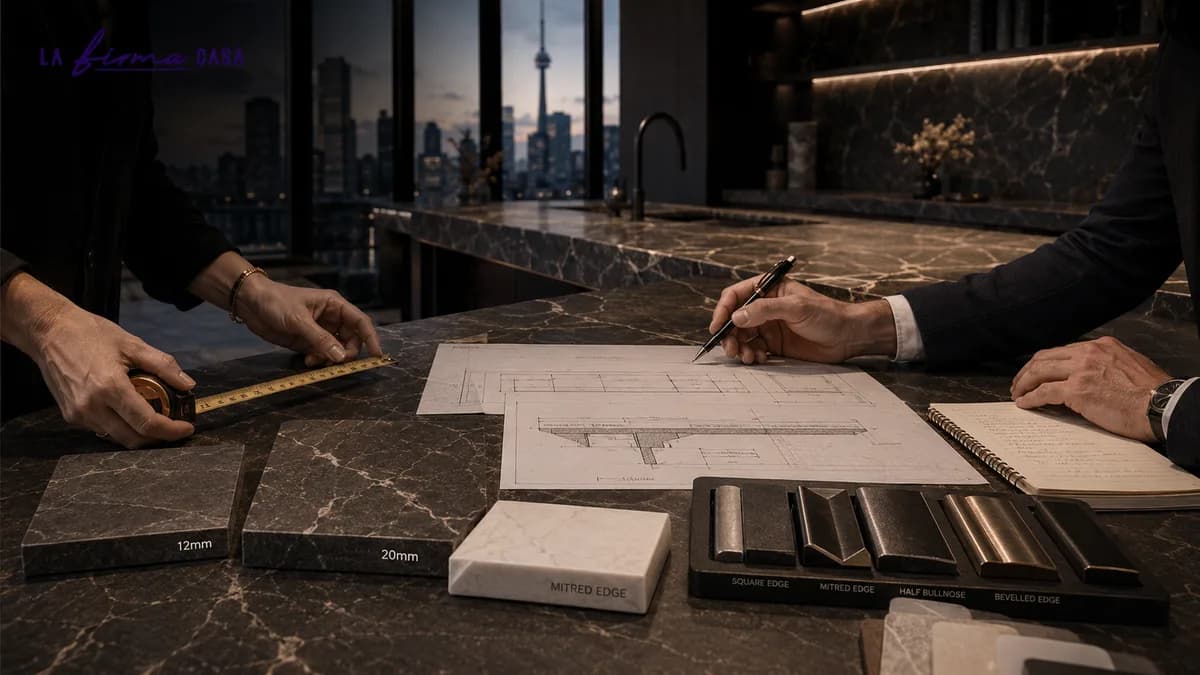
Choose the Right Edge Detail
A 12mm slab needs a mitred edge to look like solid stone. The fabricator cuts two pieces at 45 degrees and bonds them into a thicker profile.
Done well, the joint is seamless. Done poorly, the veining misaligns and the adhesive line shows. Always request photos of the fabricator’s previous mitred porcelain edges, not granite ones.
A 20mm full-body slab avoids the mitre entirely. The polished edge already reads as solid material, which is why specifiers prefer it for exposed islands.
Note: Never allow on-site cutouts with standard stone tools. Sink and hob openings must be cut with porcelain-rated CNC equipment, with rounded internal corners to prevent stress cracks.

Choose a Porcelain-Experienced Fabricator
Ask directly how many porcelain kitchens the shop has completed. Ask which brands they have worked with, and whether they are certified by any slab producer.
Confirm the warranty covers fabrication cracks, not just the material. If the answers are vague, keep looking.
Porcelain vs Quartz vs Granite
Most Canadian buyers shortlist porcelain against quartz and granite. The differences are practical, not cosmetic.
| Factor | Porcelain | Quartz | Granite |
|---|---|---|---|
| Heat resistance | Excellent | Poor, resin scorches | Good |
| Sealing needed | Never | Never | Yearly |
| Outdoor use | Yes | No, UV fades resin | Yes |
| Chip resistance | Moderate at edges | Good | Good |
| Fabricator availability in Canada | Limited | Wide | Wide |
| Pattern consistency | Printed, highly consistent | Engineered | Natural, unique |
Porcelain wins on heat, maintenance, and outdoor use. Quartz wins on edge durability and installer availability. Granite remains the value pick where natural variation is wanted.
Importing Italian Porcelain Slabs into Canada
Italy produces the most advanced large-format porcelain in the world, and most premium slabs specified in Canada are imported. Under CETA, qualifying Italian ceramic products enter Canada duty-free, though customs documentation must prove EU origin.
Freight is the real variable. Slabs ship in A-frame crates, and lead times from Italian factories typically run 8 to 14 weeks to Ontario. Order 10–15% extra material, because replacing one broken slab means waiting for the next sailing.
Import rules and tariff codes are published by the Canada Border Services Agency. Getting the paperwork wrong delays clearance and stalls the whole kitchen schedule.

Sourcing Porcelain Countertops with La Firma Casa
La Firma Casa is an interior design specification consultancy connecting Canadian projects with premium Italian and European surface brands. Through our Tiles & Slabs portfolio, we source slab materials directly from Italian producers, with samples, technical data, and CAD pricing for your project.
Our services for professionals and retailers cover selection, technical support, and full import coordination, so slabs arrive cleared, crated, and on schedule. Homeowners can access the same support through our consumer services.
One important note: we are not a design practice. In Canada, practising as an interior designer requires provincial licensing and association membership, such as ARIDO in Ontario. What we can do is connect you with qualified designers from our professional network, then handle the sourcing behind their specification.
Book a consultation to discuss porcelain surfaces for your next Canadian project.
Frequently Asked Questions
Are porcelain countertops good for Canadian kitchens? Yes. They handle hot pans, resist stains without sealing, and suit indoor and outdoor use, including freeze-thaw patio kitchens.
Do porcelain countertops chip easily? Not in daily use, but edges can chip under hard impact. Specifying 20mm thickness and clean edge fabrication greatly reduces the risk.
What thickness should I choose for porcelain countertops? Use 12mm for standard perimeter runs. Step up to 20mm for islands, seating overhangs, and outdoor kitchens.
How much do porcelain countertops cost in Canada? Expect roughly C$80 to C$160 per square foot installed. Full-body Italian slabs and mitred edges sit at the top of that range.
About the author

Written by
Interior design specification consultancy
La Firma Casa — curating European design excellence for Canadian interiors. Interior design specification consultancy with an unwavering commitment to quality.
Connect on LinkedIn