

A sofa with an Italian name, an Italian showroom and an Italian designer can be built in a factory two continents from Italy. The label will not always tell you. Authentic Italian furniture is defined by where it was made, not by who designed it or who sells it. If you are paying Italian prices for a project or a residence in Canada, you are entitled to know which side of that line the piece falls on.
The guide below explains what the Made in Italy label means in law and how the 100% Made in Italy certification goes further.
What Authentic Italian Furniture Means in Law
Italian furniture authenticity starts with a legal definition, and there are two. One is a customs rule that most brands meet. The other is a certification that fewer do.
The Made in Italy Label
Under the customs rules Italy applies as an EU member, a product is Made in Italy if its last substantial transformation took place in Italy. A sofa frame built in Italy and upholstered in Italy qualifies. A frame built abroad and only covered in Italy is a harder case, because the covering has to count as a substantial transformation. Being designed in Italy is not enough on its own, and Italian law since 2003 treats a false or misleading origin claim as a criminal offence.
That rule leaves room. A brand can source components abroad and assemble in Italy and still label the piece Made in Italy. The label tells you where the final manufacturing step happened, which is meaningful. The label does not tell you where the timber was cut, the foam was poured or the leather was tanned.
The 100% Made in Italy Certification
Article 16 of Law 166 of 2009 defines a stricter category. A product is 100% Made in Italy where its idea, design, production and development are carried out entirely in Italy. The materials are Italian semi-finished goods, and the workmanship is the traditional method of the district. The Made in Italy certification that carries that label is issued by theInstitute for the Protection of Italian Producers. The institute inspects the factory before granting it and lists certified companies on its register.
- Made in Italy: last substantial transformation in Italy, components may come from anywhere
- 100% Made in Italy: design, materials, production and development all in Italy, verified by inspection
- Designed in Italy: no origin claim at all, and no legal protection for the buyer
The Consorzio 100% Made in Italy mark is the one to look for when the origin of every component matters to you. Most of the makers La Firma Casa represents in Canada manufacture entirely in their Italian districts, and theItalian furniture in Canada page names each of them.
Why the Distinction Costs Money
Genuine Made in Italy furniture from a factory that controls every stage costs more than a piece assembled in Italy from imported parts. Both cost more than a copy. The price difference is in the labour, the materials and the years of refinement in the design. A buyer who pays the first price for the third product has lost the difference twice, once at purchase and once on resale. Luxury furniture authentication is the first thing a serious buyer of a used piece checks.
How to Identify Italian Furniture by Its Construction
Before you ask for a document, you can read the piece itself. Italian craftsmanship markers are consistent across the country’s furniture districts, and a copy rarely gets all of them right.
The Frame and the Joinery
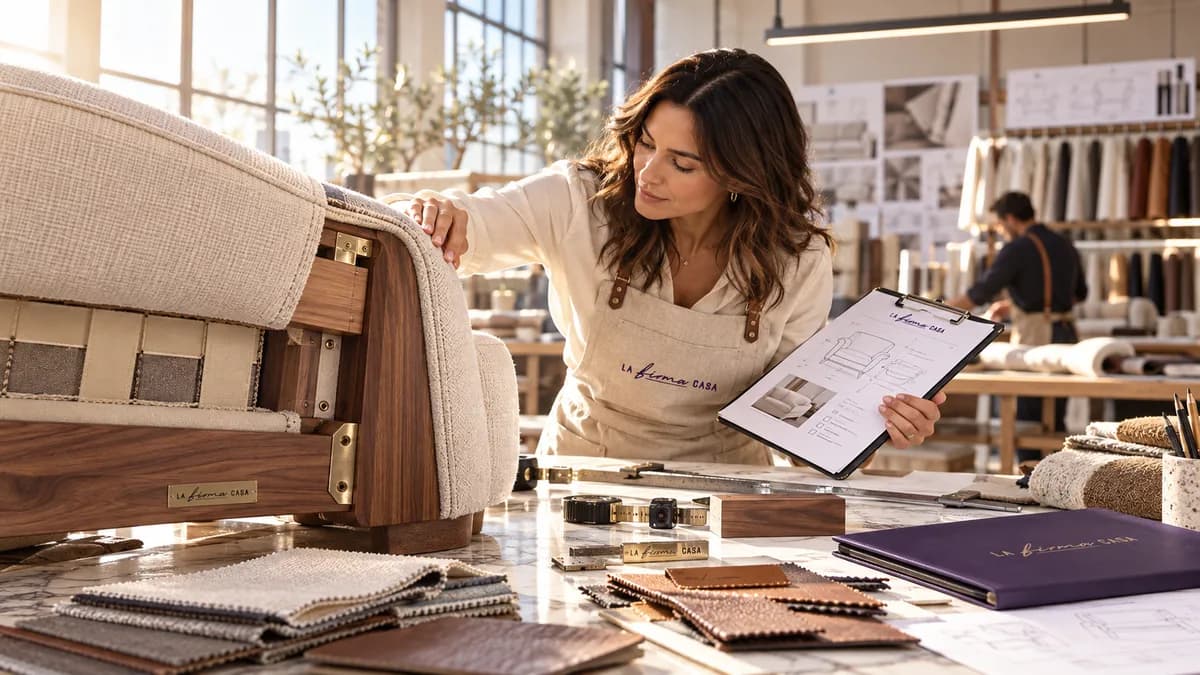
Turn a genuine Italian sofa over and the frame is kiln-dried hardwood, usually beech or poplar, with joints that are doweled, glued and screwed rather than stapled. Italian wood furniture from Brianza, the Marche and Tuscany’s upholstery district uses solid timber where it bears load and veneer only where it is decorative. The veneer is book-matched, so the grain mirrors across the surface. A frame you cannot see because the dust cover is stapled shut is a frame the maker did not want you to see.
| Marker | Genuine Italian work | What a copy usually shows |
|---|---|---|
| Frame timber | Kiln-dried beech or poplar, solid where it bears load | Softwood, particleboard or plywood throughout |
| Joints | Doweled, glued and screwed, corner-blocked | Stapled, sometimes glued |
| Suspension | Elastic webbing or sinuous springs tied by hand | Loose sinuous springs or webbing stapled at intervals |
| Foam | High-density polyurethane, often layered with feather or fibre | Single-density foam that softens within a year |
| Leather | Full-grain or top-grain, with natural markings and a hand-finished edge | Corrected grain, bonded or split leather, uniform surface |
| Veneer | Book-matched, thick enough to sand and refinish | Paper-thin, printed or mismatched at the seams |
| Hardware | Italian or German mechanisms, branded and heavy | Unbranded, light, loose in the hand |
Upholstery, Leather and Finish
Italian upholstery is cut so the pattern aligns across cushions and arms. The seams are straight, tight and finished with piping or a double stitch that does not pucker. Full-grain leather shows the natural markings of the hide, a hand-finished edge and a smell of leather rather than chemical. A lacquer or wood finish is applied in multiple coats and rubbed back, so the surface is deep rather than plastic. Run your hand along a seam and an edge. A copy is smooth where a genuine piece has texture, and rough where it has none.
The Label, the Serial and the Signature
A genuine piece carries the maker’s label with the company name and the address of the factory. In most cases the label also carries a serial or production number that the factory can trace. Many makers add a certificate of authenticity signed at the factory, and the higher end adds a signature or a stamp on the frame. The label says Made in Italy or 100% Made in Italy, never Italian design, Italian style or designed in Italy, which are the phrases a copy uses. If the label names a city that is not a furniture district, or a company the brand does not own, you are looking at a copy.
Furniture Origin Verification: The Documents That Settle It
The construction tells you whether a piece is well made. The documents tell you where. Ask for three, and treat a seller who cannot produce them as having answered.
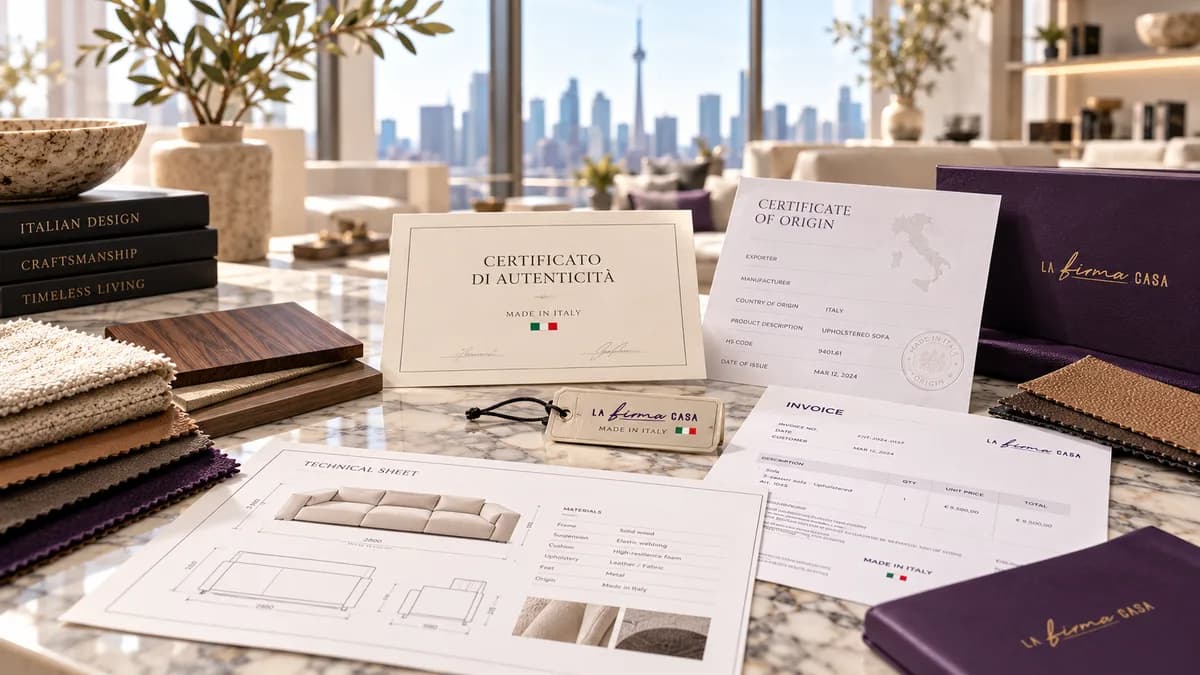
The Factory Documents to Ask For
- The maker’s certificate of authenticity or origin, naming the factory and the production date
- The commercial invoice from the manufacturer to the importer, showing the Italian address of origin
- The customs declaration or certificate of origin used to bring the piece into Canada, which states the country of origin the importer declared
A seller who imported the piece holds all three. A representative who works with the factory can obtain them before you buy. La Firma Casa does not sell furniture and does not hold stock. The firm represents Italian makers in Canada. The documentation for every piece its clients order comes from the factory that built it, through the authorised channel that fulfils the order.
The Questions That Expose a Copy
- Where is the factory, and can I see the production for this piece
- Is the frame built there or imported, and from where
- Who tanned the leather, and where
- Is the company on the 100% Made in Italy register, and if not, why not
- What is the serial number, and will the factory confirm it
Counterfeit furniture signs cluster around those questions. A seller who answers the first with a showroom address, the second with silence and the fifth with a shrug is selling a copy. Or the seller does not know what they are selling. Either way, the piece is not worth the Italian price.
Verifying the Brand Itself
Italian furniture brands are companies with factories, histories and addresses, and each of those can be checked. A maker with fifty years in Brianza or the Marche has a documented history, a registered company and a factory you can visit. A brand name that appeared three years ago with a Milan post box and a Chinese supply chain has none of those. Italian design heritage is real and traceable, and the makers La Firma Casa represents can each show you theirs, from the factory floor to the finished piece.
Verify the Factory Before You Pay the Italian Price
Three checks separate genuine Italian furniture from everything else that carries an Italian name.
- Read the construction, from the frame and joints to the leather, the veneer and the hardware
- Read the label, which says Made in Italy or 100% Made in Italy and names a factory, not a showroom
- Read the documents, which come from the factory and the customs entry and name the country of origin
If a piece you are considering passes the first two and the seller cannot produce the third, do not take the seller’s word for it. Send the maker’s name and the piece to us, and we will confirm with the factory whether it was built there and what documentation exists for it. Where the maker is one we represent in Canada, we will connect you with the authorised channel that supplies it with the papers attached.
Frequently Asked Questions
If a brand is Italian, is everything it sells made in Italy?
No. Several well-known Italian brands manufacture part of their range abroad and label those pieces accordingly, and some sell licensed designs made by other factories. Check the label on the specific piece rather than the brand’s reputation, and ask which factory built it.
Is a piece labelled Designed in Italy authentic?
Not as Italian-made furniture. Designed in Italy makes no origin claim, so the piece can be built anywhere without breaking any rule. The piece can still be well made, but you are not buying Italian manufacturing and you have no basis to expect Italian construction, materials or warranty terms.
Does the 100% Made in Italy certificate guarantee quality?
The certificate guarantees origin, verified by inspection. Every stage of design and production took place in Italy from Italian semi-finished materials. Quality follows from the maker’s standards rather than from the certificate. A factory that has submitted to the inspection is one that controls its production, and that control is where quality comes from.
Can I verify a serial number with the factory myself?
Usually yes, if the maker publishes a contact for it, and a genuine maker will confirm a serial number it issued. If you are buying through a representative or an authorised channel, ask them to obtain the confirmation in writing before the order. A confirmation before purchase is worth more than one after.
Why does authentic Italian furniture matter for a commercial project?
Because the specification, the warranty and the replacement parts all depend on the factory being who it says it is. A hotel or an office that specifies an Italian maker and receives a copy has a warranty from nobody. The project also has a fabric it cannot reorder and a piece that fails in year two. Origin verification before the order is the cheapest insurance the project buys.
About the author

Written by
Founder, La Firma Casa
Founder of La Firma Casa and a practising architect. Ummer Mughal writes on specifying Italian and European products for Canadian projects.
Connect on LinkedIn