

A sofa can look perfect in a rendering and still fail the room. The arm may block a side table, the fabric may not tolerate daily cleaning, or the boxed frame may not fit through the elevator. A proper furniture specification process catches those problems while changes are still inexpensive.
The financial context makes that discipline worth taking seriously. Statistics Canada reported that Canadian households spent an average of $76,750 on goods and services in 2023, up 14.3% from 2021. When living costs and project budgets are already under pressure, a vague furniture order is not a harmless shortcut.
This article follows furniture from the first project brief to its final installed position. You will see what belongs in a specification, who approves each decision, how imported products are costed for Canada, and what should be checked before anyone signs off.
What is furniture specification, and why is it more than choosing furniture?
Furniture specification is the written definition of what an item must be, where it belongs, how it should perform and how it will be supplied. Selection identifies a desirable product. Specification makes that product measurable, priceable, orderable, installable and verifiable.
A saved photograph is a reference, not a specification. So is a mood board. Neither tells a supplier which size, finish, fabric colour, base, electrical option or quantity to quote.
The specification becomes the shared record that connects the design concept to the furniture plan, budget, quotation, purchase order and installation list. The same item code should follow a chair from the first schedule to the room where it is placed. If the code changes every time the model changes, the paper trail becomes unreliable.
Furniture also sits inside the wider FF&E scope. FF&E means furniture, fixtures and equipment. Depending on the project, it can include loose seating, tables, rugs, decorative lighting, window treatments, artwork, appliances and custom pieces. The team should define that boundary at the start because the most expensive omissions often live between scopes.
What does a good specification accomplish?
A useful specification does five jobs at once:
- preserves the visual idea developed during concept design;
- proves that the item fits the room, user and access route;
- gives vendors the same basis for pricing;
- records approvals and revisions without relying on memory;
- tells the delivery and installation team what goes where.
The wording matters. “Walnut dining table” leaves the species, veneer cut, stain, sheen, edge profile and base finish open to interpretation. “Dining table, 2400 x 1100 mm, quarter-cut American walnut veneer, approved stain WN-03, 20% sheen, solid timber edge and blackened-steel base” gives a maker something real to price.
Canadian projects involving European products benefit from early interior design specification services in Canada because the design choice, technical documentation and import route need to agree before an order is placed.
Who is responsible for the furniture specification process?
The interior designer usually owns design intent and product selection, while a specification consultant develops technical detail and supplier coordination. The client approves cost and appearance. Manufacturers engineer custom pieces, procurement teams place orders, and installers verify delivery, assembly and placement.
Titles vary from one project to another, so responsibility should be assigned by task rather than assumed from a job title. The practical difference between an interior designer, decorator and design consultant is the scope each accepts. A homeowner may approve every residential purchase. A hotel package may involve an owner, operator, designer, purchasing agent, contractor and warehouse team.
Which decisions belong to each project member?
| Project member | Main responsibility | Typical approval or output |
|---|---|---|
| Client or owner | Brief, budget, priorities and final acceptance | Approved concept, budget and purchase authorization |
| Interior designer | Layout, visual direction, scale and coordination | Furniture plan, concept board and finish intent |
| Specification consultant | Product research, technical data and schedule control | Coordinated specification package |
| Architect or consultants | Building interface, accessibility, power and life-safety coordination | Coordinated drawings and technical comments |
| Manufacturer | Product engineering and production feasibility | Quotation, shop drawings, samples and production data |
| Procurement lead | Commercial comparison, orders, tracking and claims | Bid comparison, purchase orders and status log |
| Freight or customs team | Transport, classification and import records | Shipping plan, customs documents and release |
| Receiver and installer | Condition check, assembly, placement and reporting | Receiving report, installation record and deficiency list |
One person can hold two roles, especially in a home project. Accountability still needs to be visible. “The supplier is handling it” is not a responsibility plan.
Professional teams can use trade support for designers, architects and retailers to connect product selection with technical data, sourcing and Canadian delivery requirements.
How does furniture move from a design concept to final installation?
The furniture specification process follows a controlled sequence: define the brief, survey the space, plan the layout, select products, write specifications, secure approvals, confirm cost, place orders, monitor production, coordinate delivery, install each item and close documented deficiencies.
Skipping a stage rarely saves time. It usually moves an unanswered question downstream, where the answer costs more.
1. Define the project brief and operating needs
The brief records who will use the space, what each room must support, the desired character, the available budget and the required completion date. A family room, law-office reception and hotel lobby may all need lounge seating, but they do not need the same seat depth, cleanability or replacement plan.
Usage should be concrete. Record whether chairs move daily, whether housekeeping uses disinfectant, whether pets or children use the room, and whether a restaurant turns a table three times each evening. “Durable” means very little until the expected use is stated.
2. Survey the room and the route into it
Site measurement covers more than wall lengths. It includes finished floor levels, door swings, radiators, outlets, data points, windows, columns, ceiling heights and fixed millwork. Drawings should be checked against current site conditions before custom production.
The access survey follows the entire delivery path. Measure the loading area, vestibule, corridor turns, elevator door, cab, stair width and narrowest room opening. A sectional that fits the plan but not the elevator is still the wrong size.

3. Build the furniture plan before naming products
The plan tests function, scale and circulation using generic furniture footprints. Designers check seating capacity, conversation distance, reach to tables, door clearances and movement through the room before becoming attached to one product.
That order matters. Choosing a beautiful sectional first and forcing the room around it is backwards.
Room layouts also show where every scheduled item belongs. A code such as LIV-SF-01 can identify the living-room sofa on the plan, specification, quotation and installation list. Italian furniture and design brands available in Canada can then be filtered against the size, function and aesthetic already established.
4. Research products and compare viable options
Product research across Italian products available in Canada by category brings together dimensions, finish choices, construction, comfort, maintenance, price, warranty and lead time. The shortlist should contain products that can genuinely work, not three images that happen to share a colour.
Ask suppliers to confirm current information. Catalogues can outlive models, finishes and price lists. A lead time given six months ago should not be copied into a live schedule without checking it again.
5. Write the specification and coordinate the drawings
Each item receives a unique code and complete data. The code appears on the furniture plan, room schedule, budget, quotation request and installation drawing. Revision dates and status labels show whether an item is proposed, approved, ordered, received or complete.
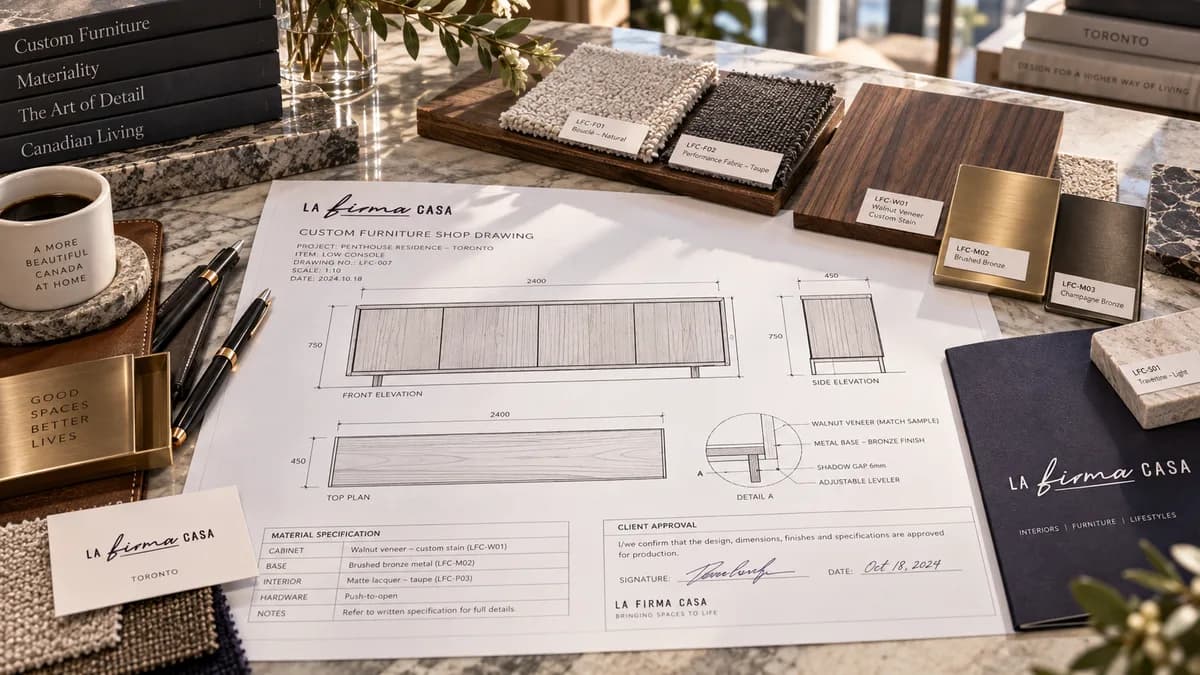
Bought products usually need a manufacturer, collection, model, SKU, dimensions, finish, upholstery, quantity, supplier, price basis and lead time. Custom products need far more: construction, joints, substrate, veneer direction, hardware, tolerances, services, drawings and approval stages.
The materials and craftsmanship used in Italian furniture deserve exact references. “Italian leather” is not a grade, colour, finish or performance description.
6. Approve samples, shop drawings and cost
Client approval should be recorded against the exact item and revision. For finishes, that means a physical sample or clearly identified control sample, not a colour viewed on two different laptop screens.
A shop drawing is the manufacturer’s technical interpretation of a custom piece. It shows how the item will be built, divided, fixed and assembled. The designer reviews it against the design intent, while the manufacturer remains responsible for its engineering and fabrication method.
Large repeated packages may need a prototype or model room. Approving one control unit before releasing 80 identical nightstands is cheaper than documenting the same fault 80 times.
7. Compare quotations on the same basis
Every bidder should receive the same specification, quantity and delivery assumptions. Otherwise, the cheapest quote may simply exclude crating, installation, upholstery, duties or a required finish.
A bid comparison should normalize currency, taxes, freight, storage, installation, warranty and exclusions. Alternates need a line-by-line technical review. “Equivalent” is a claim to be tested, not a category to accept.
8. Place the order and control production
The purchase order should reference the approved specification, quotation, revision, finish samples, delivery address, payment schedule and required date. A deposit without those records leaves too much open after money has changed hands.
During production, the team tracks shop drawing closure, material availability, sample approvals, manufacturing progress and factory completion. Any substitution needs written approval before it enters production. Verbal substitutions are how coordinated rooms end up with almost-matching metal finishes.
9. Coordinate freight, receiving and installation
Imported furniture may pass through export packing, international freight, customs release, local transport, warehouse receiving and staged delivery before reaching the room. Crate labels should use the same item and room codes as the installation plan.
Receiving staff inspect quantities and visible condition, photograph damage, and record overages, shortages and discrepancies. Installers then assemble, place, level and protect items according to the approved plan. Packaging removal and final cleaning should be part of the scope, not a surprise conversation at 5 p.m.
10. Complete the deficiency list and handover
The final walk-through records damage, missing components, wrong finishes, unstable pieces, poor alignment and placement errors. Each deficiency receives an owner, required action and due date.
Handover should include warranties, care instructions, spare materials, finish codes, supplier contacts and a final item schedule. A room is not truly complete if the owner cannot identify the fabric when one cushion needs replacement.
What information belongs on a furniture specification sheet?
A furniture specification sheet should identify the item, room, quantity, manufacturer, model, dimensions, materials, finishes, upholstery, performance, price basis, supplier, lead time and status. It should also carry images, drawings, approvals, revision history, delivery notes and installation requirements.
The following table is a practical core rather than a universal template. Category-specific fields should be added for seating, tables, storage, lighting or custom furniture.
| Specification field | Why it matters | Example entry |
|---|---|---|
| Item code | Connects every project record | LIV-SF-01 |
| Item and location | Defines what and where | Sectional sofa, main living room |
| Manufacturer and model | Identifies the exact product | Brand, collection and model number |
| Dimensions and orientation | Confirms fit and handing | 3050 W x 1050 D x 760 H mm, left chaise |
| Quantity | Controls pricing and delivery | 1 unit |
| Materials and construction | Defines quality and build | Kiln-dried hardwood frame, moulded foam |
| Finish reference | Prevents subjective colour matching | Oak stain OA-04, 15% sheen |
| Upholstery reference | Makes the textile orderable | Mill, collection, pattern, colour and treatment |
| Performance requirement | Matches real use | Commercial abrasion rating, cleanable finish |
| Supplier and contact | Establishes the source | Dealer name, representative and email |
| Unit and extended price | Connects selection to budget | CAD price, quantity and extension |
| Lead time and validity date | Protects the programme | 16 weeks from deposit, checked 22 Sept 2026 |
| Approval and status | Shows decision stage | Client approved, revision 03 |
| Logistics notes | Prepares delivery | Two-piece frame, blanket-wrap, elevator booking |
| Supporting records | Preserves evidence | Cut sheet, quote, sample, shop drawing and warranty |
An item should be understandable without the author standing beside it. If the installer must phone the designer to determine which bedroom receives which bench, the schedule is unfinished.
How do budget, lead time and landed cost affect furniture specification in Canada?
Canadian furniture budgets should use landed cost, not catalogue price. Landed cost can include the product, currency conversion, crating, freight, insurance, brokerage, duty, tax, storage, local delivery and installation. Lead times must also include approvals, production, transit, customs and site readiness.
The budget should be allocated by room and category before the shortlist becomes emotional. A project can spend more on the primary sofa and dining table, then simplify occasional pieces that carry less functional weight. Equal spending across every item is rarely the smartest distribution.
Imported products need a dated cost basis because exchange rates, freight and supplier pricing move. The Canada Border Services Agency explains that tariff classification, country of origin and tariff treatment determine applicable duties. GST is calculated on the value of the goods plus applicable duties. Preferential treatment may apply, but the importer needs the correct origin records rather than assuming every product shipped from Europe qualifies.
What should be included in a landed-cost review?
- Confirm the quoted currency and how long the price remains valid.
- Identify the Incoterm, which states where the seller’s cost and risk end.
- Add export packing, inland transport and international freight.
- Check insurance, brokerage, duty, tax and customs-related charges.
- Allow for receiving, inspection, storage and redelivery.
- Add assembly, placement, protection and packaging removal.
- Keep a contingency for changes, damage or extended storage.
Lead time begins only when the supplier’s conditions are satisfied. That may mean a deposit, approved shop drawing, approved finish sample and confirmed fabric availability. “Twelve weeks” is incomplete unless the start point and shipping basis are written down.
How are custom and imported Italian pieces specified differently?
Custom and imported Italian furniture requires tighter control of dimensions, materials, shop drawings, samples, approvals, packing and transport. The specification must bridge metric drawings, Canadian site conditions, regional electrical requirements, customs records and local installation so design intent survives the journey.
Custom furniture starts with a design requirement rather than a finished SKU. The specification must define visible surfaces and the hidden build: substrates, internal framing, joints, edge details, hardware, service openings, load expectations and how the piece separates for delivery.
Material language should remain precise. Timber needs a species, cut, match, stain and sheen. Stone needs a type, finish, thickness and edge. Upholstery needs the textile maker, collection, pattern, colourway and treatment. Metal needs a base material and finish process, not just “bronze.”
Authentic manufacturers such as Ulivi Salotti and Ceppi srl provide different collections, construction methods and customization options. A consultant should translate those possibilities into a project-specific order instead of copying a catalogue description.
Electrified furniture deserves a separate check. In Ontario, the Electrical Safety Authority requires electrical products to carry a recognized approval mark or field-evaluation label. A European plug adapter does not turn an unapproved component into approved equipment. Integrated outlets, lighting, motors and controls should be reviewed before shipment.

What should be checked before furniture delivery and installation?
Before delivery, confirm site readiness, access, elevator bookings, floor protection, item counts, room labels, assembly needs and responsible contacts. On arrival, inspect packaging and products before placement. Installation should end with a documented walk-through, deficiency list, correction dates and signed acceptance.
Construction dust, incomplete flooring and unprotected corners can ruin finished furniture in minutes. Delivery should not proceed because the truck is booked if the room is not ready.
Pre-delivery site checklist
- finished floors and walls are complete, cured and protected;
- wet trades and major dusty work are finished;
- loading access, parking and elevator times are confirmed;
- door, corridor, stair and elevator clearances remain available;
- power, lighting and data connections are ready where required;
- rooms and item locations match the latest installation plan;
- security, building management and insurance requirements are cleared;
- installers know assembly, anchoring and waste-removal responsibilities;
- a clean, dry area is available for short-term staging;
- the receiver has the purchase order, packing list and camera ready.
Photograph cartons or crates before opening when damage is visible. Record the carrier, item code and condition immediately. Throwing away packaging before inspection can weaken a freight claim.
During installation, check orientation, level, stability, alignment and protection. Confirm that adjustable glides suit the floor and that wall-mounted pieces use the correct substrate and fixing method. The installer should not improvise an anchor into an unknown wall assembly.

Which furniture specification mistakes cause the most expensive problems?
The costliest mistakes are vague finishes, unchecked dimensions, missing access measurements, incomplete landed costs, stale lead times, verbal approvals and uncontrolled substitutions. Late site readiness and weak receiving records make matters worse because responsibility becomes difficult to prove after damage or delay.
Treating selection as specification
A product link and screenshot do not record the approved version. Websites change, and one collection may contain several sizes, bases and finish groups. Save the technical sheet and write the exact choice into the schedule.
Approving colour from a screen
Screens distort colour, scale and texture. Physical samples are essential for upholstery, wood, stone and metal when visual consistency matters. Signed samples should be labelled with the project, item code, finish code and approval date.
Forgetting tolerance and site variation
Built dimensions are not always identical to tender drawings. Recheck critical openings and built-in interfaces before production. A five-millimetre conflict is tiny on paper and infuriating when a cabinet sits proud of a wall.
Comparing incomplete quotations
One vendor may include crating and delivery while another quotes ex-factory. Comparing their bottom lines without normalizing scope rewards the less complete quote.
Allowing substitutions without a formal review
An alternate fabric can change colour, cleanability, abrasion performance, price and delivery. Review each affected attribute and obtain written approval. “Closest available” is not a technical standard.
Working with specification consultants on complex Toronto projects can reduce the gaps between design decisions, vendor information and site coordination.
How does furniture specification change by project type?
The core furniture specification process stays consistent, but project priorities change. Homes emphasize comfort and personal preference. Offices prioritize ergonomics and reconfiguration. Hospitality projects need repeatability and maintenance. Retail spaces focus on traffic and brand expression, while multi-unit developments demand strict quantity and revision control.
| Project type | Specification priority | Common risk |
|---|---|---|
| Private residence | Comfort, proportion, finish quality and access | Buying by appearance before confirming scale |
| Condominium | Elevator access, assembly and compact planning | A large item cannot reach the unit |
| Workplace | Ergonomics, power integration and future reconfiguration | Technology or electrical options are not coordinated |
| Restaurant | Cleanability, stability, traffic and replacement | Residential-grade finishes wear too quickly |
| Hotel | Repeatability, maintenance, room coding and spares | One error is multiplied across repeated rooms |
| Retail | Brand alignment, traffic flow and visual merchandising | Displays obstruct movement or cannot be reconfigured |
| Multi-unit residential | Quantity, phasing, finish consistency and storage | Full delivery arrives before floors are ready |
Homeowners need no less technical care than commercial teams. They simply have fewer repeated items and more personal decisions. Design consultation and technical guidance for homeowners can keep a residential package coherent without turning the home into a commercial specification exercise.
When should the furniture specification process begin?
Furniture planning should begin during concept design, before walls, outlets and budgets are fixed. Early layouts reveal spatial and service needs. Detailed specifications develop during design development, while long-lead or custom items should be approved early enough for production, import and installation before occupancy.
The furniture schedule should not wait until construction is nearly finished. A desk with integrated power affects outlet positions. A wall-mounted headboard affects blocking. A large table may affect pendant location. Late furniture decisions send changes back into completed work.
A practical sequence is:
- concept stage: brief, budget range, generic layout and design direction;
- design development: shortlist, dimensions, technical research and preliminary pricing;
- approval stage: final selections, samples, shop drawings and landed-cost sign-off;
- procurement stage: orders, production tracking, freight and receiving plan;
- installation stage: site readiness, placement, deficiencies and handover.
Long-lead pieces should be identified before the rest of the package is finished. Ordering everything together feels tidy, but it can allow one custom item to control the entire completion date.
What do clients ask about furniture specification?
Clients usually want to know how specification differs from procurement, how long the work takes, what documents they approve, whether imported pieces meet Canadian requirements and who handles installation problems. Clear scope and written decision records answer most of those concerns.
Frequently Asked Questions
What is the difference between furniture selection and furniture specification?
Furniture selection chooses the product. Furniture specification records the exact model, size, finish, material, quantity, location, performance, supplier, cost basis, lead time and approval needed to quote, order and install it correctly.
Is furniture specification the same as procurement?
No. Specification defines the required item. Procurement obtains quotations, places orders, manages payment and production, tracks delivery and resolves commercial issues using the approved specification as its basis.
How long does the furniture specification process take?
The duration depends on scope, approvals and customization. A single residential room may take weeks, while a custom home, workplace or hotel can require several months of specification before production and shipping begin.
What is an FF&E schedule?
An FF&E schedule is the organized register of furniture, fixtures and equipment for a project. It connects item codes, rooms, quantities, specifications, costs, approvals, orders and delivery status in one controlled record.
Who approves a custom furniture shop drawing?
The designer or appointed consultant usually reviews the shop drawing for design intent, dimensions and interfaces, while the client approves commercial or visible decisions as agreed. The manufacturer remains responsible for engineering and fabrication.
Can furniture be ordered before every finish is approved?
Only when the purchase order clearly separates what is released from what remains pending. Starting production with unresolved finishes creates avoidable risk and may limit the client’s right to reject a result later.
What happens if furniture arrives damaged?
The receiver should photograph the packaging and item, record the damage against the item code, retain relevant packing material and notify the carrier or supplier within the claim period. The deficiency log should track repair, replacement and closure.
Do imported European furniture products need Canadian approval?
Ordinary furniture requirements vary by product and use. Electrical components require special attention, and applicable import, labelling, building, fire, accessibility or project standards should be confirmed before ordering rather than assumed from European documentation.
About the author

Written by
Founder, La Firma Casa
Founder of La Firma Casa and a practising architect. Ummer Mughal writes on specifying Italian and European products for Canadian projects.
Connect on LinkedIn