

If you are opening a hotel in Canada in the next twelve months, three things will decide whether the furniture is in place on the day. Whether the Italian pieces were ordered before the production slots filled.
Whether every piece was specified to a contract standard the brand and the fire code accept. Whether the landed cost included freight, customs, installation and attic stock, or only the factory price. Hotel furniture procurement is a schedule before it is a shopping list.
The guide below runs through the six stages from specification to installation and the standards and budget rules a Canadian project has to meet.
Hotel Furniture Procurement: The Six Stages and Their Timelines
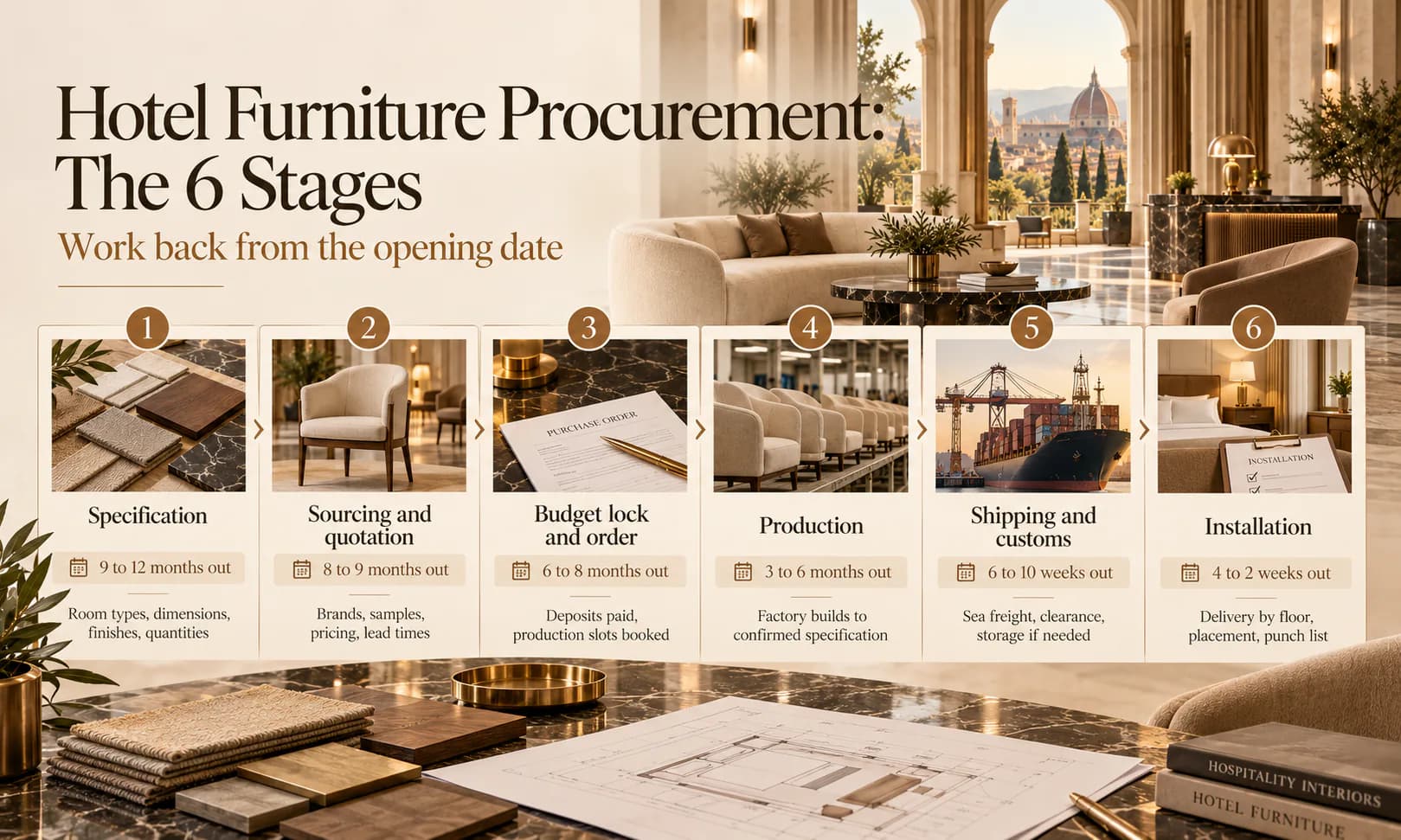
Hospitality FF&E procurement runs in a fixed order, and each stage has a date that sets the next. The table gives the order for a mid-size hotel with Italian made-to-order pieces in the public areas.
| Stage | What happens | When, working back from opening |
|---|---|---|
| Specification | Every piece scheduled by room type, with dimensions, materials, finishes and quantities | Nine to twelve months out |
| Sourcing and quotation | Brands matched to the specification, samples reviewed, pricing and lead times confirmed | Eight to nine months out |
| Budget lock and order | Quantities fixed, deposits paid, production slots booked | Six to eight months out |
| Production | Factory builds to the confirmed specification | Three to six months out |
| Shipping and customs | Sea freight, clearance, bonded storage if the site is not ready | Six to ten weeks out |
| Installation | Delivery by floor, placement, inspection, punch list | Four to two weeks out |
Specification
A hotel furniture specification is a schedule, not a mood board. Each room type gets a line for every piece, with the dimension, the material, the finish, the quantity and the standard it has to meet. The guestroom schedule for a 150-key hotel runs to about 40 lines, and the public areas add as many again. The schedule is what the makers quote against, so a vague line produces a vague price.
- One line per piece per room type, with quantity multiplied by key count
- Dimensions checked against the room drawings, including door and corridor clearances
- Materials and finishes named, with alternates where the budget needs them
- Standards named per piece, for durability and flammability
- Attic stock added, usually 2 to 5 percent, for replacements in year one
Sourcing, Quotation and Budget Lock
With the schedule fixed, sourcing matches each line to a maker. Contract furniture from Italian factories is quoted per specification, with a lead time and a production slot attached to the price. Samples of fabric, leather, timber finish and stone arrive for review under the project’s lighting, and the schedule is revised where a finish does not work.
FF&E budget planning closes at this stage. Quantities are locked, deposits are paid, and the production slot is booked. A change after this point costs a re-quote and, more often, a lost slot. That is why the budget lock sits six to eight months before opening rather than three.
Production, Shipping and Installation
Italian makers build to the confirmed specification over eight to fourteen weeks, depending on the piece and the season. Sea freight to a Canadian port takes four to six weeks, and clearance and inland delivery add one to two. If the site is behind, the furniture goes into bonded storage rather than onto an unfinished floor. Installation runs by floor, with placement, inspection against the schedule and a punch list for the pieces that need attention.
Hospitality Furniture Procurement Standards, Warranties and Budgets
A hotel piece is used ten times harder than a residential one. The standards, the warranty and the budget rules that follow are what separate contract furniture from the catalogue furniture it resembles.
Durability and Flammability Standards
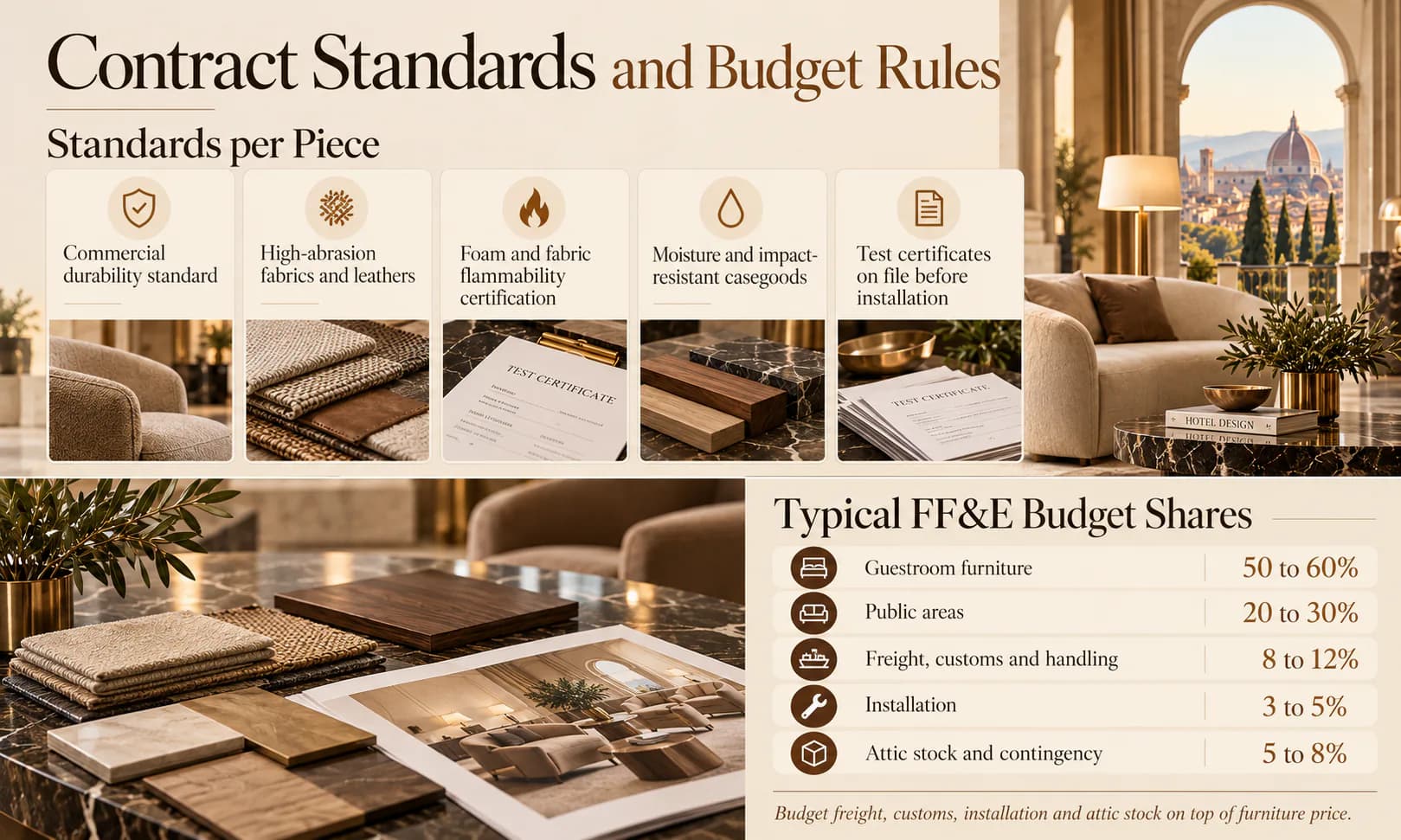
Contract seating is specified to a durability standard. In North America that is usually the BIFMA standard for lounge and public seating, which tests frames, seats and arms for repeated load over a simulated service life. Guestroom casegoods are specified for moisture, abrasion and impact resistance on the surfaces guests touch. Upholstered pieces in public areas carry the flammability test the project’s fire code and the brand standard require. The fabric and foam are certified to it before the piece is built.
- Lounge and public seating tested to a recognised commercial durability standard
- Fabrics and leathers at a commercial abrasion rating, well above residential grade
- Foam and fabric certified to the flammability test the project requires
- Casegoods finished for moisture and impact, with edge protection on high-traffic surfaces
- Test certificates on file per piece before installation
Furniture warranty and durability are linked. A commercial warranty from an Italian maker usually runs two to five years on frames and mechanisms, with fabrics and leathers covered for defects rather than wear. A residential warranty does not survive hotel use, and a piece bought at residential grade to save budget is replaced at hotel cost.
FF&E Budget Planning
FF&E budget planning starts from a cost per key and works down to a cost per line. Guestroom furniture, public areas, back of house and attic stock each get a share. Freight, duty, installation and contingency sit on top of the furniture price rather than inside it. The mistake is budgeting the furniture and forgetting the rest.
| Budget line | What it covers | Typical share of FF&E |
|---|---|---|
| Guestroom furniture | Beds, headboards, casegoods, seating, per key | 50 to 60 percent |
| Public areas | Lobby, lounge, restaurant, meeting rooms | 20 to 30 percent |
| Freight, customs and handling | Sea freight, clearance, inland delivery, storage | 8 to 12 percent |
| Installation | Delivery by floor, placement, inspection | 3 to 5 percent |
| Attic stock and contingency | Replacements and change orders | 5 to 8 percent |
Landed Cost from Italy
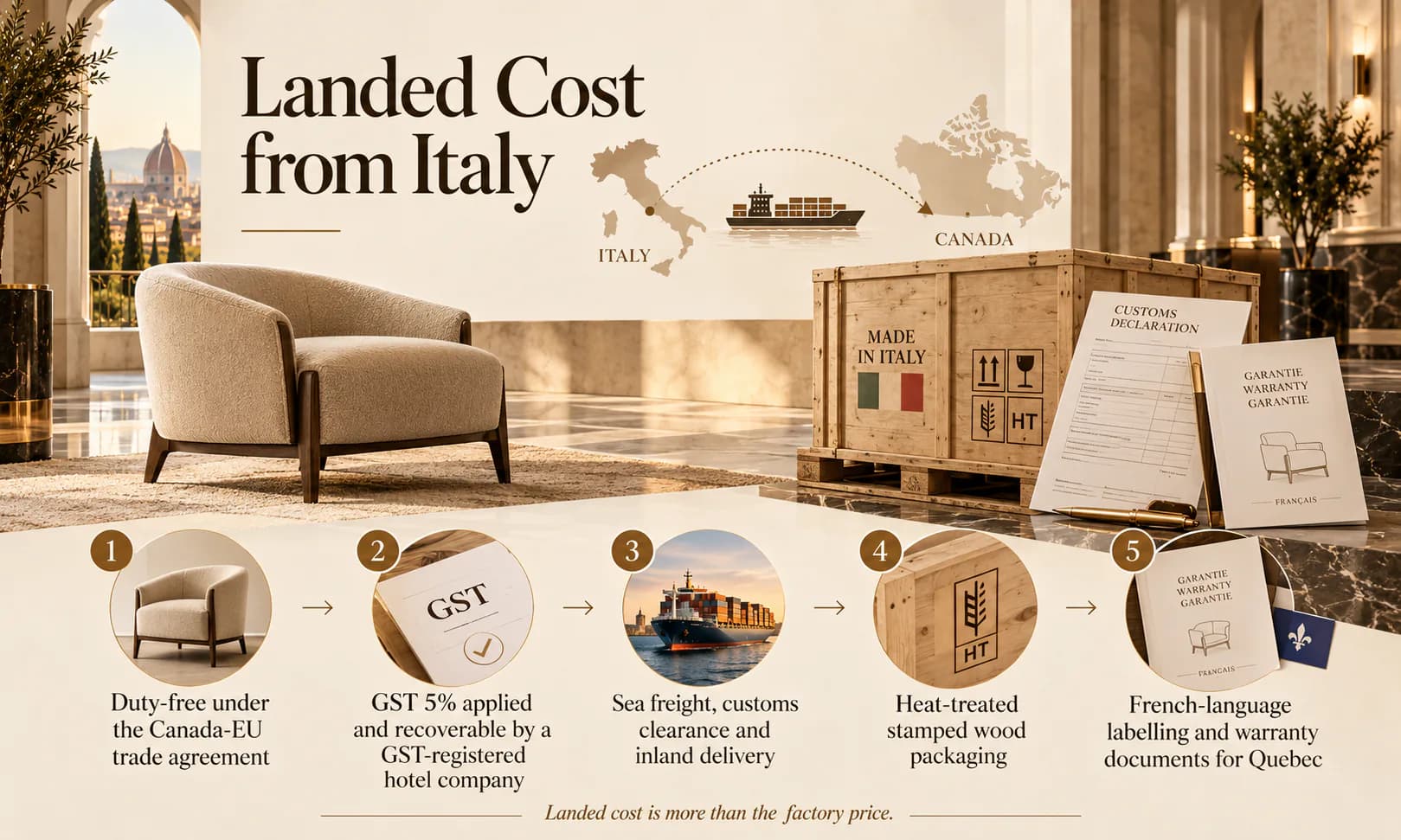
Italian furniture enters Canada duty-free under the Canada-European Union trade agreement, which has applied since September 2017 and removed tariffs on 98 percent of tariff lines, including furniture. Upholstered seating from countries without an agreement can carry duty of up to 9.5 percent, so the origin decides part of the landed cost. GST of 5 percent applies on the value for duty, and a GST-registered hotel company recovers it. Wood packaging has to be heat-treated and stamped, and any furniture sold in Quebec needs French-language labelling and warranty documents.
Hotel FF&E Procurement in Canada: Reaching the Makers
Hotel furniture suppliers Canada projects rely on fall into two groups. Domestic commercial furniture suppliers stock contract lines for fast delivery. Italian and European makers build to specification and reach Canada through representatives and authorised channels. Most projects use both.
What Italian Contract Makers Offer a Hotel
Italian factories have supplied hospitality for decades, and their catalogues include contract-grade versions of residential designs. Ulivi Salotti builds lounge and lobby seating to the fabric, leather and configuration the schedule specifies, on frames made for continuous use. Gyform makes upholstered beds and headboards to the height and fabric of the guestroom design, in the quantities a key count demands. Tafaruci produces dining and meeting tables to the length and top material the room needs. Target Point’s Nova table runs in the marbles and sizes a restaurant schedule calls for. Each is bulk furniture ordering at factory level, built to one specification across a hundred rooms.
How a Canadian Project Reaches Them
Italian makers sell through authorised channels in each country, and in Canada that means a licensed importer or retailer carrying the brand. La Firma Casa does not manufacture or sell furniture. The firm represents nine Italian furniture makers in Canada and prepares the specification with the project’s designer or procurement team. From there it connects the project with the brand and the authorised channel that fulfils the order. The professional and retailer services cover the technical side of that connection.
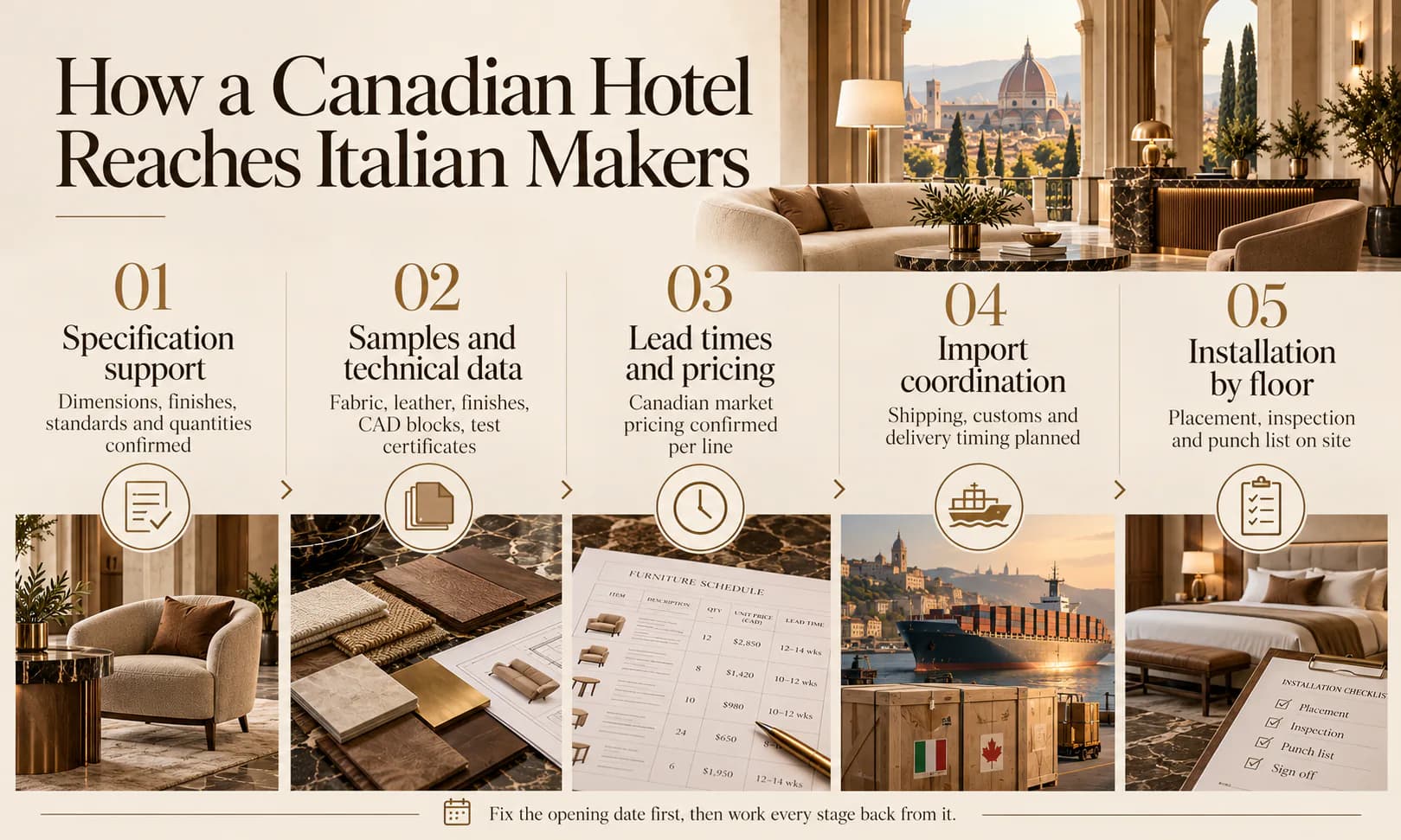
- Specification support: dimensions, finishes, standards and quantities confirmed with the factory before quotation
- Samples and technical data: fabric, leather and finish samples, CAD blocks and test certificates for the design team
- Lead times and pricing for the Canadian market, per line, from each maker
- Import coordination: shipping, customs and delivery timing planned with the authorised channel against the opening date
Hotel Renovation Furniture
A renovation runs on the same six stages compressed, because the hotel is trading around the work. Floors close in sequence, the furniture for each floor arrives the week it is needed, and storage on site is measured in days. Hotel renovation furniture is therefore ordered by floor rather than by project, with the production slots staggered to the closure plan. The hospitality project timeline for a renovation is set by the floor sequence, and the procurement calendar follows it exactly.
Fix the Opening Date, Then Work Every Stage Back From It
Every stage of hotel interior design procurement is dated from the opening, and the order date for Italian pieces falls six to eight months before it.
- Schedule every piece by room type with dimensions, materials, standards and quantities before sourcing begins
- Lock the budget and place orders six to eight months before opening, with production slots booked
- Allow eight to fourteen weeks for production and six to eight for shipping and clearance from Italy
- Specify contract durability and flammability standards per piece, with certificates on file
- Budget freight, customs, installation, attic stock and contingency on top of the furniture price
La Firma Casa represents Italian makers in Canada and connects designers, developers and procurement teams with them. The furniture is built and sold by the makers and their authorised channels. What La Firma Casa provides is the specification, the technical data and the import coordination that get the right piece to the right floor on the right date. Book a consultation to set the procurement calendar for your hotel project.
Frequently Asked Questions
How far before opening does a hotel have to order made-to-order furniture from Italy?
Six to eight months. Production takes eight to fourteen weeks, shipping and clearance six to eight, and installation needs two to four weeks on site. A project that fixes its opening in September orders its Italian pieces by January or February, and any piece ordered later comes from domestic stock.
Is Italian hotel furniture more expensive to land in Canada than furniture from Asia?
Not on duty. Italian furniture enters duty-free under the Canada-EU agreement, while upholstered seating from countries without an agreement can carry duty of up to 9.5 percent. Freight from Italy is comparable to freight from Asia. The factory price is where the two differ, and the warranty and service life sit behind that difference.
Can a hotel buy directly from an Italian furniture factory?
Usually not. Italian makers sell through authorised importers and retailers in each country. A representative such as La Firma Casa connects the project with the brand and the authorised Canadian channel, prepares the specification and coordinates the import. The purchase runs through the licensed channel.
What happens if the site is not ready when the furniture arrives?
The furniture goes into bonded or third-party storage near the site until the floors are ready. Storage costs money by the week, so the shipping date is planned against the construction schedule rather than the production date. A representative coordinating the import will hold the shipment in Italy where the site delay is known early enough.
How much attic stock does a hotel need?
Two to five percent of the guestroom quantities for the pieces most likely to be damaged, such as chairs, side tables and headboard fabric. Attic stock is ordered with the main run so it matches exactly. A replacement ordered two years later from a different production batch rarely does.
Disclaimer: The information provided in this blog is for general informational purposes only. For professional assistance and advice, please contact experts.
About the author

Written by
Interior design specification consultancy
La Firma Casa — curating European design excellence for Canadian interiors. Interior design specification consultancy with an unwavering commitment to quality.
Connect on LinkedIn
Reviewed by
Ummer Mughal, Founder of La Firma Casa and a practising architect