

Every April, Canadian designers come home from Salone del Mobile with a phone full of sofa photos and one nagging question: how do I actually get this here? Figuring out how to buy Italian furniture in Canada, from duties to lead times to real CAD pricing, is where most people stall. And the demand is real. Canada just broke into the top ten export markets for Italy’s furniture industry, with sales up 9% in 2025 even as Italian exports to the US fell 8.2%, according toIl Sole 24 Ore.
So Canadians are buying more Italian furniture than ever. Most are still overpaying or waiting longer than they should.
This guide covers the full picture: your buying options, what CETA means for duty, realistic 2026 pricing in Canadian dollars, honest lead times, and the checks that save you from expensive surprises.
What Are Your Options for Buying Italian Furniture in Canada?

You have three main routes: buy from a Canadian retailer that stocks Italian lines, order directly from an Italian manufacturer or dealer, or work with a Canadian-based brand representative who handles specification, ordering, and import for you. Each trades off price, effort, and risk differently.
Buying through a Canadian retailer or showroom
Showrooms in Toronto, Vancouver, and Montréal carry a curated slice of Italian brands. You see pieces in person, pay in CAD, and delivery is someone else’s problem. The trade-off is markup, since retail overhead gets built into the price, and selection. A showroom floor holds maybe 40 pieces. An Italian factory’s catalogue holds thousands, in hundreds of finishes.
Ordering directly from Italy
Direct ordering gets you factory pricing and the full catalogue. It also makes you the importer of record. That means arranging freight, insurance, customs paperwork, CETA origin documents, and white-glove delivery yourself, in a different language and time zone. For one statement piece it can work. For a whole home or a condo project, it becomes a part-time job. Nobody warns you about the 6 a.m. calls with the freight forwarder.
There’s a fourth route: online marketplaces reselling “Italian design.” We’d steer you away from it. Authentic pieces from real manufacturers rarely reach those channels, and replica sellers have become very good at borrowing product photography. If a Molteni-quality sofa is priced like a mattress-in-a-box, it isn’t one.
Working with a Canadian brand representative
Quick comparison:
- Retailer:easiest, priciest per piece, limited selection
- Direct from Italy:best list price, most work and risk on you
- Local representative:full catalogue access, CAD quotes, import handled, the route most designers and serious buyers end up taking as representative local support available as per canadian timezone along with physical samples and we work as your associate to support the design process.
Do You Pay Import Duties on Italian Furniture in Canada?
Usually, no. Under the Canada–EU trade agreement (CETA), furniture made in Italy enters Canada duty-free, saving you the 6% to 9.5% tariff charged otherwise. You still pay GST or HST. The catch: your shipment needs the right origin paperwork to claim the zero rate.
That paperwork trips up more first-time importers than anything else.
How does CETA make Italian furniture duty-free?
CETA, the Comprehensive Economic and Trade Agreement, has applied between Canada and the EU since September 21, 2017, and it eliminated tariffs on about 98% of EU goods, furniture included. TheGovernment of Canada’s CETA overviewcovers the full agreement. Without CETA treatment, furniture under Chapter 94 of the Customs Tariff carries Most-Favoured-Nation duty of roughly 6% to 9.5% depending on the piece. On a C$16,000 sofa, that’s up to C$1,520 you don’t need to pay.
But zero duty isn’t automatic. Three things must be in place:
- An origin declaration.The Italian exporter adds specific CETA wording to the commercial invoice. A “Made in Italy” label or line on the invoice does not count; customs will assess full duty on it.
- A REX number.For shipments over €6,000, the exporter must be registered in the EU’s Registered Exporter system and quote that number in the declaration.
- Genuine EU origin.The piece must actually qualify as EU-made under CETA’s rules of origin. Established Italian manufacturers know this drill well.
You can confirm the exact tariff line for any piece with the freeCanada Tariff Finder, the official tool run by the Trade Commissioner Service, BDC, and EDC.
Worth knowing while you compare options: Canada’s anti-dumping measures on upholstered seating target imports from China and Vietnam, where surtaxes can multiply a landed price. Italian-made pieces sit entirely outside those measures. Another quiet advantage of buying the real thing.
What taxes do you still pay?
GST or HST applies to imported furniture the same way it applies to anything else you buy. At the border, commercial imports are assessed 5% GST on the duty-paid value; the provincial portion follows depending on how and where you buy. Budget for your full provincial rate either way:
| Province | Sales tax structure | Total rate |
|---|---|---|
| Ontario | 13% HST | 13% |
| Quebec | 5% GST + 9.975% QST | 14.975% |
| British Columbia | 5% GST + 7% PST | 12% |
| Alberta | 5% GST only | 5% |
| Nova Scotia | 14% HST (reduced from 15% in April 2025) | 14% |
| New Brunswick, NL, PEI | 15% HST | 15% |
| Saskatchewan | 5% GST + 6% PST | 11% |
| Manitoba | 5% GST + 7% RST | 12% |
One more wrinkle: for casual (personal) imports, CBSA collects the provincial portion at the border for HST provinces, while PST provinces like BC handle it separately. Commercial importers pay 5% GST at entry and manage the rest through their tax filings. If that sentence made your eyes glaze over, that’s the argument for not being your own importer.
Who actually handles the customs entry?
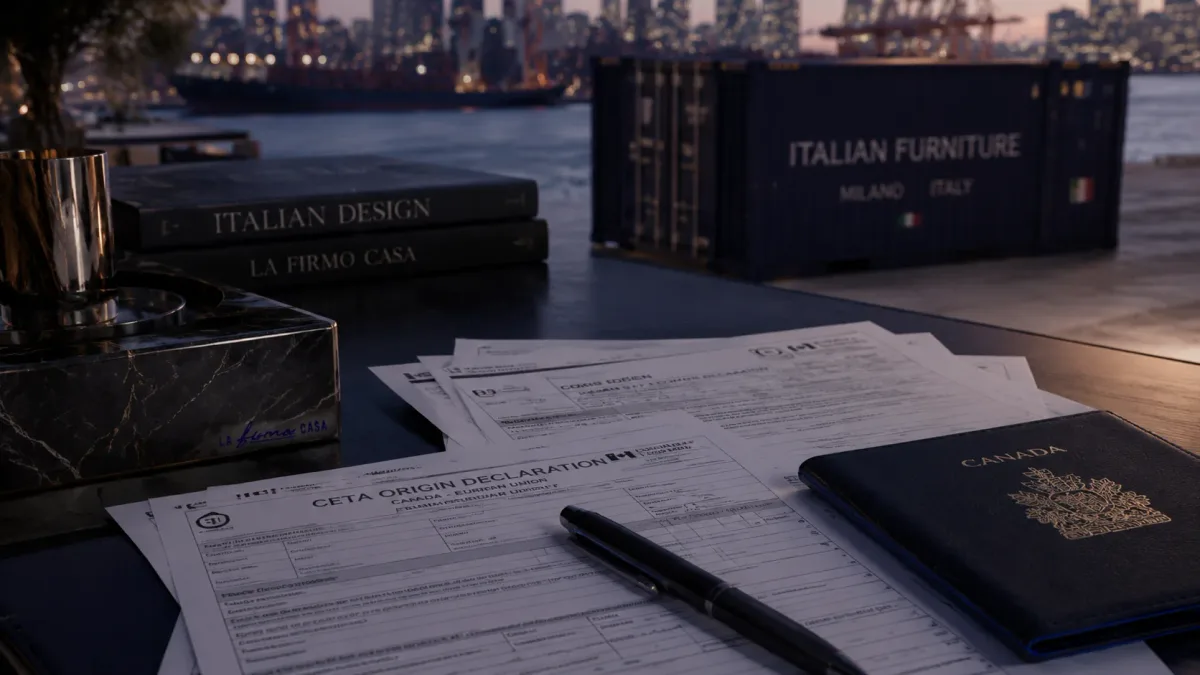
Someone must be the importer of record: the party legally responsible for the declaration, the duty claim, and any reassessment CBSA issues later. Buy from a showroom or representative and that’s them, not you. Import directly and it’s you, which since 2024 also means registering in CBSA’s CARM portal for commercial entries, posting security, and keeping origin records for six years. A licensed customs broker files the entry either way; brokerage on a furniture shipment typically runs C$300 to C$600.
Working with a representative collapses all of this: you’re invoiced in CAD with tax handled like any domestic purchase, and the customs file (classification, origin declaration, brokerage) runs through ourlogistics and import management serviceinstead of your inbox.
How Much Does Italian Furniture Cost in Canada? (CAD Pricing for 2026)
Expect to pay roughly C$8,000 to C$25,000 for a designer Italian sofa landed in Canada, C$6,000 to C$20,000 for a dining table, and C$800 to C$2,500 per dining chair. Landed cost typically runs 30% to 40% over Italian list price after freight, tax, and delivery.
Those ranges are wide because Italian pricing is spec-driven. The same sofa frame can double in price between a catalogue fabric and a premium aniline leather. That’s not upselling. It’s howItalian materials and craftsmanshipare priced at the factory.
Typical 2026 price ranges by category
| Category | Entry designer level | Mid-to-premium | High-end / bespoke |
|---|---|---|---|
| Sofas & sectionals | C$8,000–12,000 | C$12,000–25,000 | C$25,000+ |
| Dining tables | C$6,000–10,000 | C$10,000–20,000 | C$20,000+ |
| Dining chairs (each) | C$800–1,200 | C$1,200–2,500 | C$2,500+ |
| Beds | C$5,000–9,000 | C$9,000–15,000 | C$15,000+ |
| Wardrobes & closet systems | C$10,000–18,000 | C$18,000–40,000 | C$40,000+ |
Treat these as planning figures; final numbers depend on brand, dimensions, and finish. At July 2026 exchange rates (€1 ≈ C$1.62), currency alone moves Canadian pricing more than most buyers realize, so a firm CAD quote matters.
What does a real landed cost look like?
Here’s the honest math on a €10,000 made-to-order sofa shipped to Toronto:
- Furniture value:€10,000 ≈ C$16,200 at €1 = C$1.62
- Sea freight (LCL), export crating, and insurance:about C$2,200 for a single large piece
- Customs brokerage and port handling:roughly C$500
- Import duty under CETA:C$0, versus about C$1,540 at the 9.5% MFN rate if the origin paperwork is missing
- HST for an Ontario buyer:13% on the goods, about C$2,106
- Landed total: roughly C$21,000, about 30% over the Italian list price
And that’s the well-managed version. Get the origin declaration wrong and this same sofa costs C$22,500.
How do payment and currency work?
Italian factories quote in euros and want a 40–50% deposit to start production, with the balance due before the piece ships. Order directly and you carry the exchange-rate risk for the full production window. On a 12-week build, a three-cent move in EUR/CAD changes a €20,000 order by nearly C$1,000 in either direction. A Canadian representative absorbs that by quoting a firm CAD price up front. Wire fees and currency-conversion spreads are small line items, but they’re real; banks routinely take 2–3% on the conversion unless you use a dedicated FX service.
What drives the price up or down?
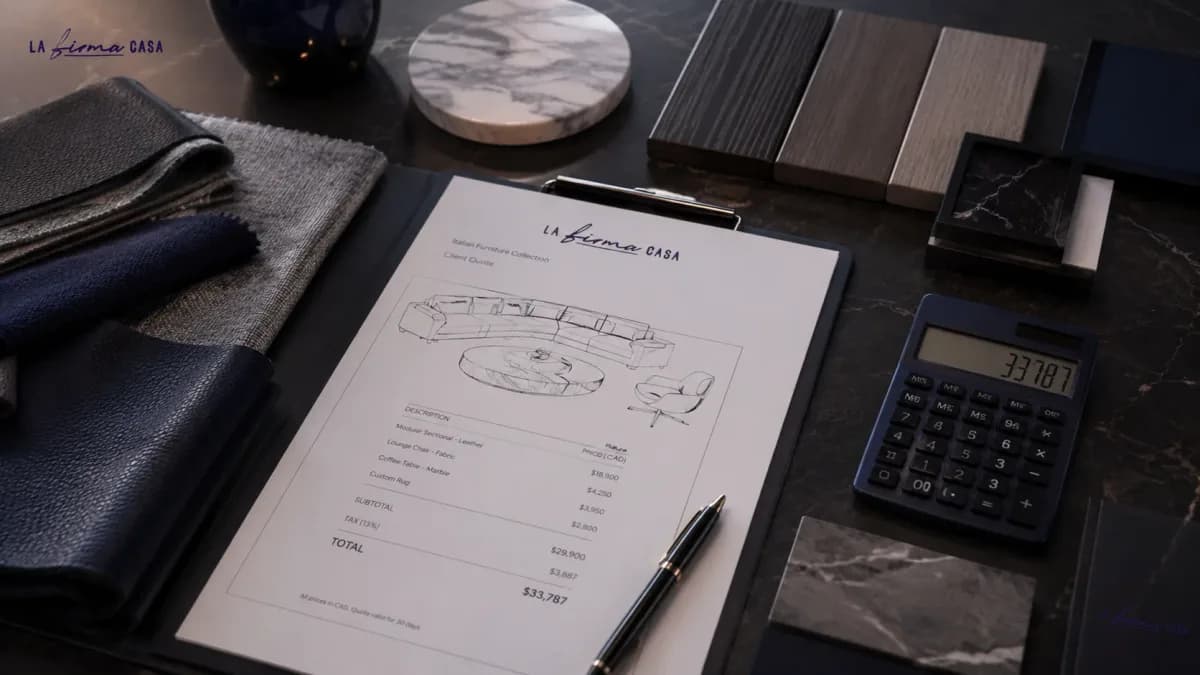
Materials do the heavy lifting: leather grade, wood species, marble type, metal finishes. Customization adds cost but not always much, because Italian factories are built for made-to-order, which is why a custom width often costs less than people expect. Consolidation matters too. Shipping five pieces in one container costs far less per piece than five separate shipments, one reason whole-room orders through a single supplier price out surprisingly well. Homeowners can see how this works in practice through ourconsumer design services.
How Long Does Italian Furniture Take to Arrive in Canada?
Plan for 12 to 20 weeks door to door for made-to-order pieces: 6 to 12 weeks of production in Italy, 4 to 6 weeks of sea freight, plus customs clearance and white-glove delivery. Air freight cuts transit to 7 to 14 days at a steep premium.
Italian furniture is built when you order it, not pulled from a warehouse. That’s the point, and the reason for the wait.
| Stage | Typical duration |
|---|---|
| Order confirmation & technical drawings | 1–2 weeks |
| Production at the factory | 6–12 weeks (16+ for complex bespoke) |
| Sea freight, Italy to Canadian port | 4–6 weeks |
| Customs clearance | 2–7 days |
| Local delivery & installation | 1–2 weeks |
A few realities worth knowing. August is a holiday month in Italy, when factories close for two to three weeks, and orders placed in July often don’t start production until September. December brings a shorter shutdown. And after Salone del Mobile each spring, new collections create order backlogs; if a piece from the2026 trend cycleis on your list, order early.
For project deadlines, work backwards. A September occupancy needs orders confirmed by April, May at the latest. We build a two-to-three-week buffer into every schedule we quote, because ships get delayed and ports get busy. Rushing the last mile with air freight is possible, but nobody enjoys paying air rates on a sectional.
Can you get Italian furniture faster?

Sometimes. Several manufacturers run quick-ship programs: a limited set of best-selling models in standard finishes, held in stock and ready to sail within one to two weeks of ordering. Showroom floor models are another shortcut, usually discounted 15–30%, though you take the finish that’s on the floor. And smaller items like lighting, accent chairs, and art often ship air economically because the math on a 30-kilogram box differs completely from a 130-kilogram sofa. If your timeline is fixed, say so at the first conversation; it changes which brands and collections we’d put in front of you.
What Should You Check Before You Place an Order?
Verify five things before money moves: the seller’s authorization to sell the brand, CETA origin documentation, exact specifications in writing, delivery access at your address, and the deposit and warranty terms. Ten minutes of checking here prevents months of dispute later.
The full pre-order checklist:
- Brand authorization.Confirm the seller is an authorized dealer or official representative. Grey-market pieces exist, and they usually surface when a warranty claim goes nowhere.
- CETA paperwork commitment.Ask, in writing, whether invoices will carry the CETA origin declaration and REX number. If the answer is vague, your “duty-free” purchase may not be.
- Specifications in writing.Finish codes, fabric or leather references, dimensions, orientation (left-facing or right-facing chaise?), leg finishes. Italian factories build exactly what the order form says, which is only good news if the order form is right.
- Site access.Measure doorways, stairwells, and condo elevators before ordering, not after the truck arrives. Toronto condo freight elevators have ended more sofa dreams than any tariff. Ourbuyer’s guide for small spacescovers what fits where.
- Deposit, balance, and warranty terms.Standard structure is 40–50% deposit at order, balance before shipment. Know who holds responsibility for transit damage, and insist on full-value cargo insurance, not carrier minimums.

How Do Designers and Developers Buy Italian Furniture for Canadian Projects?
Trade buyers work through brand representatives or manufacturer trade programs to access trade pricing, technical files, and consolidated logistics. For multi-unit or hospitality projects, orders consolidate into container shipments with staged deliveries, which is where the per-piece economics genuinely improve.
The process differs from a consumer purchase in useful ways. Designers specify from the full factory range, not a showroom floor, with CAD blocks, finish samples, and fire-rating or contract-grade documentation supplied per piece. Pricing is trade-structured, and quotes arrive in CAD with duties and freight already modelled, with no surprises for the client budget at 90% construction.
Condo developers and hotel groups push this further. A 40-suite boutique hotel furnished from three or four Italian factories ships as consolidated FCL containers, clears customs as one entry, and delivers floor by floor against the construction schedule. Freight per piece drops sharply, and one CETA origin file covers the lot. We’ve seen European-furnished amenity spaces become the line in the sales brochure that moves pre-construction units. Buyers notice the difference even when they can’t name the brand.
And the support runs past the invoice. Lead-time planning against project milestones, replacement parts years later, training for sales teams on what “made in Italy” actually means in a spec sheet. That’s the infrastructure behind ourservices for professionals and retailers. For a closer look at project work, seehow Italian brands elevate Canadian residential and hospitality projects.
Is Buying Italian Furniture in Canada Worth It?
For pieces you’ll live with for decades, yes. Italian makers hold 9.2% of the global high-end furniture market: kiln-dried hardwood frames, hand-tied suspension, leathers and stone volume retailers can’t offer. With duty at zero under CETA, Canadians pay closer to European prices than most markets.
Our view, plainly: a C$15,000 Italian sofa that lasts 25 years beats three C$6,000 sofas that last eight each. The math works even before you factor in how the piece looks in year ten. That quality difference is a big part ofwhy Italian furniture defines modern luxury living in Toronto homes.
There’s also what the piece does for the rest of the room. Italian manufacturers design in collections of sofas, armchairs, coffee tables, and lighting meant to sit together, which is why a single well-chosen piece often resets the standard for everything around it. Designers know this. Homeowners usually discover it about a month after delivery, when the old side tables suddenly look wrong.
The honest caveat: if you need furniture in your living room within three weeks, made-to-order Italian isn’t your route; a quick-ship program or floor model is. For everything else, the wait is the price of getting exactly what you specified. Most of our clients say the second order is easier than the first. By then, the process feels less like importing and more like ordering.
Ready to source a specific brand or price a whole project in CAD?Talk to our teamand we’ll quote real numbers, with duties, freight, and timelines already built in.
Frequently Asked Questions
Is Italian furniture duty-free in Canada?
Yes, when it qualifies under CETA and ships with a proper origin declaration (plus a REX number for shipments over €6,000). Without that paperwork, Chapter 94 furniture faces Most-Favoured-Nation duty of roughly 6% to 9.5%.
How much does it cost to ship furniture from Italy to Canada?
Roughly C$1,500 to C$3,000 for a single large piece by sea (LCL), including export crating and insurance. Full container loads for whole-home orders run higher in total but far less per piece.
Do I pay HST on imported Italian furniture?
Yes. Duty may be zero under CETA, but GST/HST always applies: 13% in Ontario, 14.975% combined in Quebec, 12% in BC. Tax is calculated on the duty-paid value of the goods.
How long does custom Italian furniture take to arrive in Canada?
Twelve to 20 weeks door to door is typical: 6–12 weeks production, 4–6 weeks sea freight, then clearance and delivery. Add buffer for August and December factory closures in Italy.
Is it cheaper to buy Italian furniture directly from Italy?
Sometimes on list price, rarely on landed cost. Once you add freight, insurance, brokerage, and the risk of missing CETA paperwork, a Canadian representative with factory-direct pricing usually lands within a few percent, without the risk sitting on you.
What is a CETA origin declaration?
A specific statement the EU exporter places on the commercial invoice certifying the goods are of EU origin. It’s the document that makes the 0% duty rate valid; a “Made in Italy” label alone doesn’t qualify.
Can interior designers get trade pricing on Italian furniture in Canada?
Yes. Designers, architects, and retailers working through a brand representative access trade pricing, technical specification support, CAD files and finish samples, and consolidated project logistics, typically well below showroom retail.
When is the best time of year to order Italian furniture?
January through March, and September through October. Orders placed then avoid the August factory shutdown and the post-Salone spring backlog, and pieces ordered by early autumn generally arrive before the December holiday close.
Who is the importer of record when buying Italian furniture?
Whoever legally brings the goods into Canada. Buy through a Canadian showroom or representative and it’s them; they carry the customs risk. Order directly from Italy and it’s you, including CARM registration for commercial entries and six years of record-keeping
About the author

Written by
Founder, La Firma Casa
Founder of La Firma Casa and a practising architect. Ummer Mughal writes on specifying Italian and European products for Canadian projects.
Connect on LinkedIn